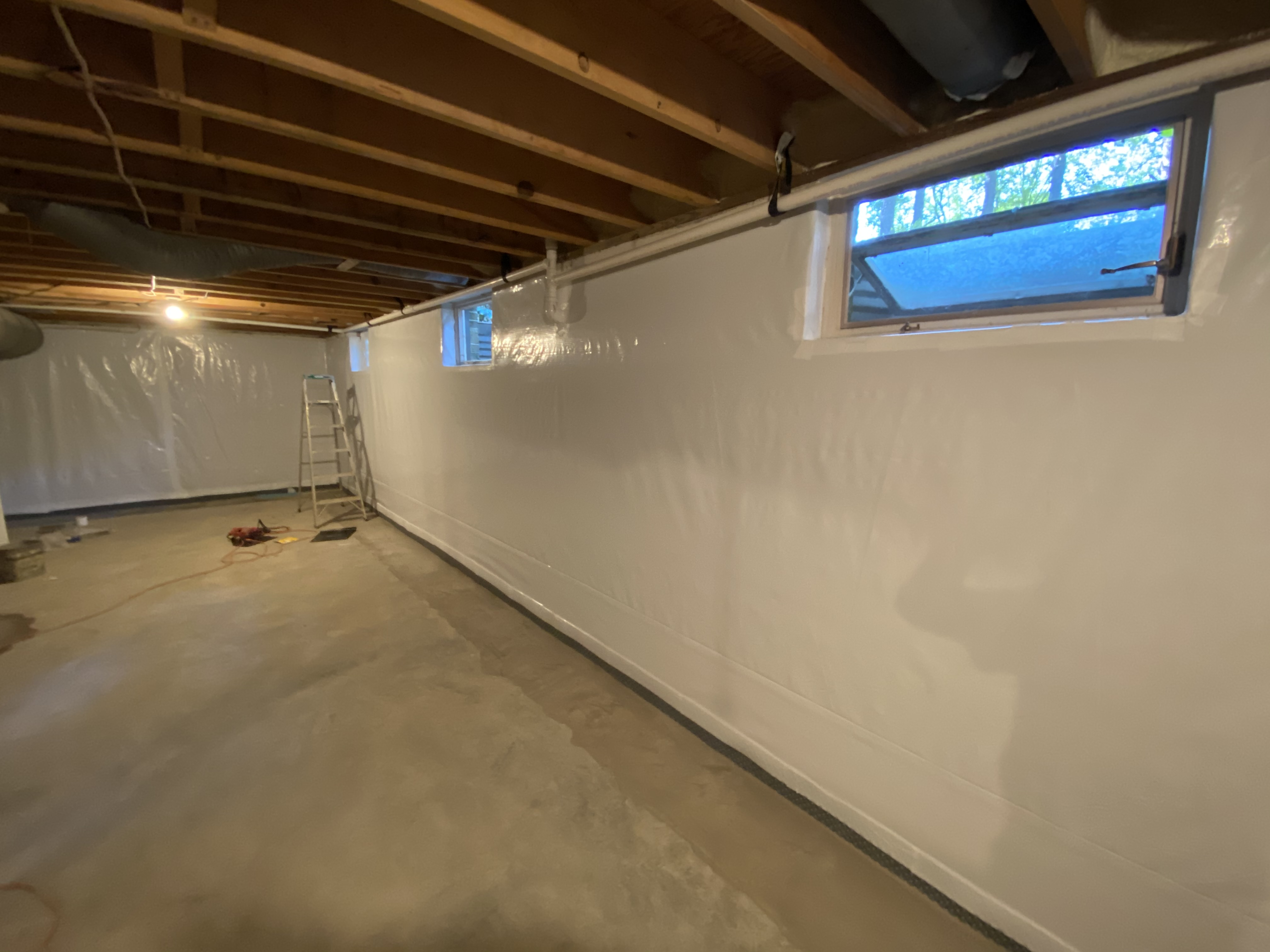
If you have been living on the Eastern Shore for any length of time, you likely know the feeling of dread that comes with a heavy storm forecast. For many homeowners, the basement becomes a focal point of anxiety, a space that, under the right pressure, seems to invite water in.
However, many homeowners also fall into a trap during the cooler, drier months: complacency. Because the air feels less humid and you aren't seeing immediate puddles, it is easy to assume the basement is fine, and that the issue has resolved itself.
At Total Home Performance, we know that basement moisture is rarely a seasonal accident. It is a symptom of a systemic issue in how your home interacts with the environment. If you are seeing signs of moisture, the time to address it is not during a storm, but long before the clouds roll in.
The "Cool Weather" Fallacy
Many homeowners believe that because the summer humidity has passed, their basement is no longer at risk. But in building science, moisture management is a year-round necessity.
Water intrusion is often caused by hydrostatic pressure: the force of water in the soil pushing against your foundation walls. This pressure doesn't disappear just because the temperature drops; it is always there, waiting for the next saturated weather event. When you ignore the signs in the fall or winter, you are simply waiting for the spring thaw or the next heavy rain to reveal the damage you’ve already been living with.
Your Basement Is More Than Just Dark Storage
In building science, we categorize your home by its "thermal boundary", the system that separates your conditioned living space from the outdoors. While many people think of their basement as a separate, concrete box, it is actually the foundation of the indoor air quality (IAQ) of an entire home.
Because of the "stack effect", the natural process where warm air above the crawl space is replaced by air pulled in from the bottom of your house, your basement air doesn't stay in the basement. If there is moisture, mold spores, or musty odors in your basement, they are being actively circulated into your living areas every single day.
Diagnostic Signs: What to Look For in a Wet Basement
Don’t wait for a flood to tell you there is a problem. Look for these early warning signs that your basement is struggling:
- Efflorescence: That white, powdery residue on concrete walls? That’s mineral deposits left behind by water moving through your foundation. It is a clear sign that water is passing through your walls.
- Peeling Paint or Stains: This is often evidence of past moisture intrusion.
- Rust on Metal Objects: If your furnace, water heater, or metal tools are showing signs of rust, the air in your basement is consistently too humid.
- The Musty Smell: If you feel the need to use air fresheners or candles to hide a smell in your basement, the basement is hiding a moisture source.
The Total Home Performance Approach: Diagnosis Before Prescription
We do not believe in one-size-fits-all solutions. Many contractors will simply suggest a sump pump or a surface seal, but these are often just temporary fixes. Our process is rooted in a diagnostic-first philosophy:
- Crawl Space or Basement Evaluation: We evaluate your home as a system. We check your grading (is the ground sloping toward the house?), gutter discharge (is water being dumped against your foundation?), and overall structural health.
- Water Management: If exterior water control isn't enough, we design integrated systems, such as professional-grade drainage and sump pumps (including backup batteries) to manage hydrostatic pressure safely.
- Moisture Control: We prescribe dehumidification only if the data shows it is necessary to maintain proper humidity levels (under 60%), ensuring your indoor air quality remains healthy year-round.
Is Your Basement Storm-Ready?
Storm season is simply a stress test for your home. If your foundation isn't ready now, it won't be ready when the pressure is on.