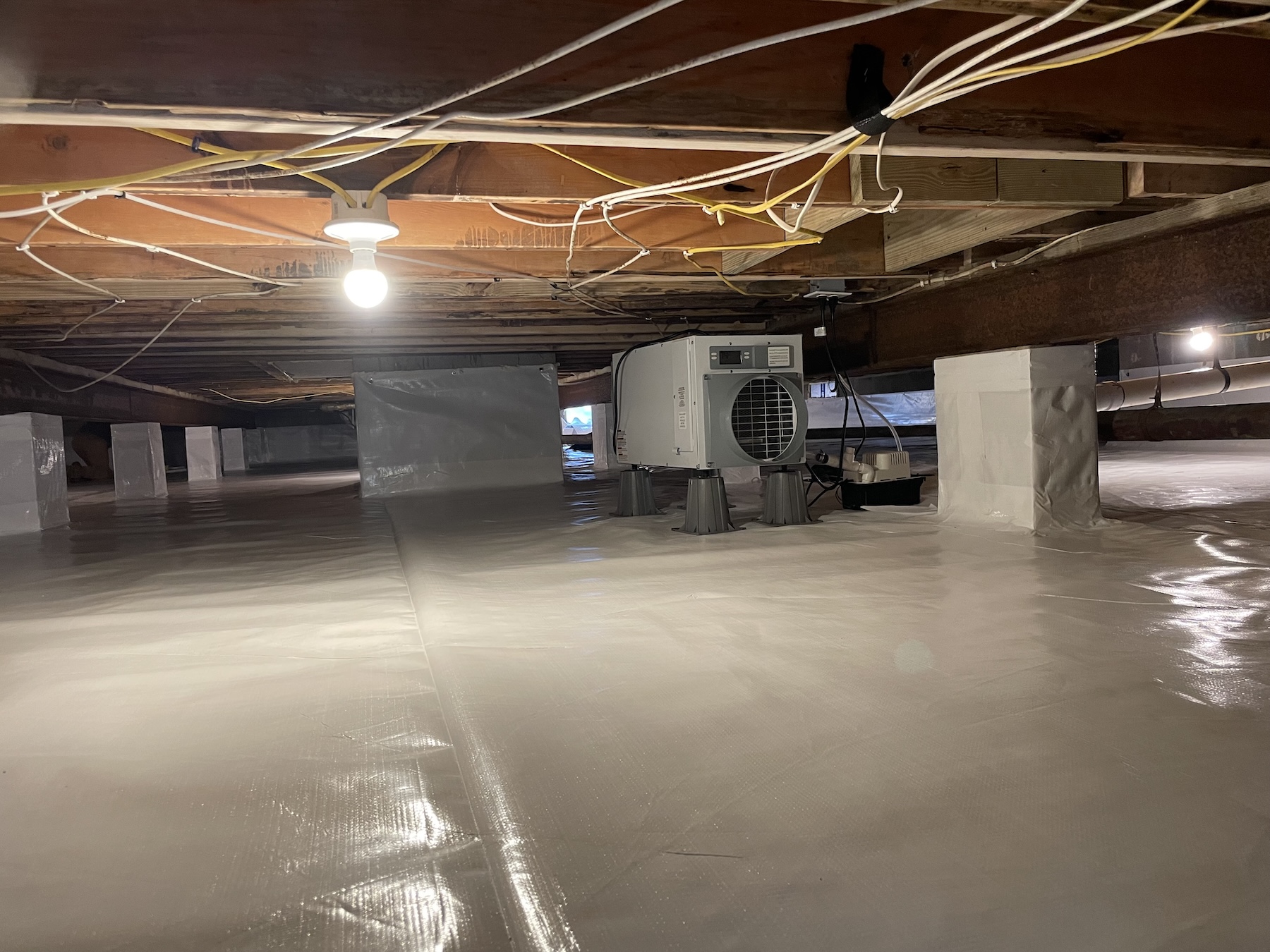
Crawl space dehumidifiers are one of the most commonly recommended solutions for moisture problems under the home. In certain situations, they are absolutely the right tool. In others, they are installed too early or used as a substitute for fixes that should have come first.
If you are researching a dehumidifier for your crawl spaces, the most important thing to understand is: A dehumidifier can control humidity, but it does not stop moisture from getting in.
Knowing when crawl space dehumidifier installation helps, and when it does not, is the key to solving moisture problems for the long term in Eastern Shore homes.
What a Crawl Space Dehumidifier Actually Does
A dehumidifier removes excess moisture from the air. By lowering relative humidity, they help reduce condensation, musty odors, and mold growth. Many modern crawl space dehumidifiers also include built-in pumps, allowing collected water to be discharged safely away from the home.
What a dehumidifier does not do is stop moisture infiltration at the source through sealing the crawl space, blocking ground moisture, or preventing humid outdoor air from entering.
When Crawl Space Dehumidifier Installation Helps
Crawl space dehumidifier installation is most effective when it is used as part of a broader moisture control strategy.
It often helps when a crawl space has already been sealed or encapsulated, but humidity remains elevated from past accumulation. It is also useful when minor moisture loads persist after air sealing and vapor barrier installation. In these cases, a properly sized crawl space dehumidifier with a pump can maintain healthy humidity levels and protect the work that has already been done.
In short, dehumidifiers work best when they are supporting a controlled environment, not trying to fix an uncontrolled one.
When a Crawl Space Dehumidifier Does Not Work
This is where many homeowners are misled: Using a dehumidifier alone is treating the symptom, not the cause.
Installing a dehumidifier in a leaky or poorly sealed crawl space often leads to disappointing results. If vents are open, air leaks are present, or ground moisture is exposed, humid air will continue to enter faster than the dehumidifier can remove it. The unit runs constantly, energy use increases, and moisture problems persist.
A dehumidifier also does not solve water issues, which must be addressed first:
-
Standing water
-
Drainage problems
-
Plumbing leaks
-
Poor exterior grading
The Role of Dehumidifiers in a Whole-Home System
From a building science perspective, crawl space dehumidifiers are a supporting component, not a standalone fix.
Moisture in a crawl space affects more than just the area under the house. Because of the stack effect, air from the crawl space often moves upward into the living space. That means crawl space humidity can influence indoor air quality, comfort, and even energy use throughout the home.
When crawl space dehumidifier installation is combined with the air sealing, vapor barriers, insulation, and proper drainage of crawl space encapsulation, it helps stabilize the entire home, not just the crawl space.
Choosing the Right Crawl Space Dehumidifier
Not all crawl space dehumidifiers are the same. Proper sizing matters, and features like automatic drainage pumps are often essential in Eastern Shore homes.
At Total Home Performance, we do not recommend or install crawl space dehumidifiers until we understand how moisture is entering the crawl space and how the home is functioning as a system. This ensures the equipment selected is correctly sized and actually solves the problem instead of masking it.
Crawl Space Dehumidifier Installation in Easton, MD, and the Chesapeake Bay
If you are considering installing a dehumidifier in your crawl space, the best first step is to understand whether it will actually help your specific home. At Total Home Performance, we use building science diagnostic techniques and our many years of experience to determine when crawl space dehumidification is appropriate and what other improvements are needed to make it effective.